The Names in the Margin: Why Loose Connections Hold Us Together
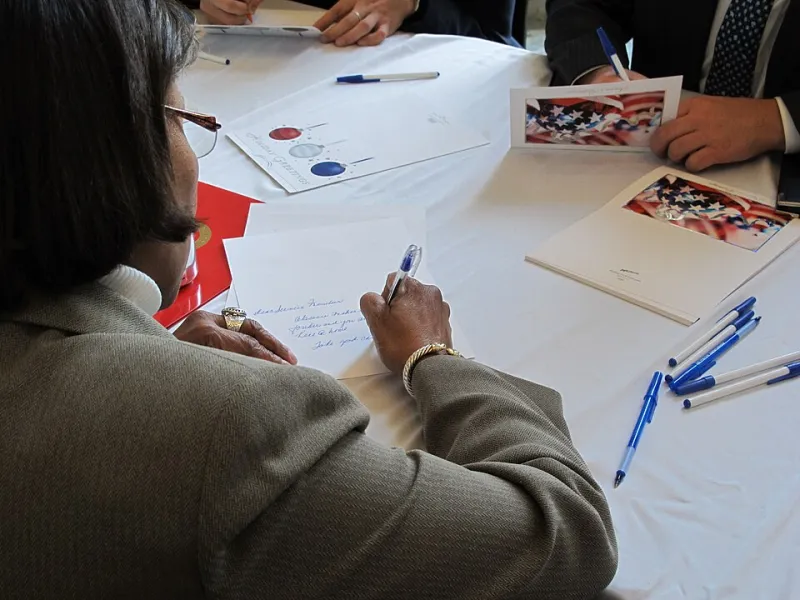
Photo: Marcia Fudge, Public domain, via Wikimedia Commons
By mid-November 2026, the holiday card displays are up, the shipping deadlines are circulating, and somewhere in your house there is a list. Maybe it is a spreadsheet. Maybe it is a stack of envelopes with three names crossed out and two added in pencil. For a lot of people navigating collapse anxiety, that list can feel like one more obligation—or worse, one more inventory of people they have not kept up with well enough.
But there is another way to look at it. That list is not just a mailing task. It is a rough map of your loose connections: the old coworker, the neighbor you wave to, the parent from your kid's soccer team, the person you sat next to at a wedding in 2019 and genuinely liked. These are weak ties, and they matter more for resilience than they usually get credit for.
The acquaintance is not a lesser relationship
Weak ties are the people we know but do not know deeply. They are not strangers, and they are not our inner circle. They are the middle ground—the people who know a different slice of our lives, who can offer a fresh perspective, a small favor, or simply the pleasant friction of being recognized by someone outside our usual orbit.
Psychologists have been interested in this middle ground for decades. Mark Granovetter's classic 1973 work on weak ties showed how loose connections can be surprisingly valuable for information and opportunity. More recent research has looked at well-being, too. A 2014 study by Sandstrom and Dunn found that interactions with weak ties—even brief, casual ones—were associated with greater feelings of belonging and happiness. A large 2022 field experiment in Science complicated the story by showing that moderately weak ties can be especially useful for job mobility, but the broader takeaway holds: the people at the edges of our social worlds are not social padding. They are part of the structure.
For community mental health, that structure matters. Strong ties give us deep support. Weak ties give us range. They connect us to different information, different neighborhoods, different generations, and different ways of coping. In uncertain times, that range is a form of steadiness. It reminds us that we are not only members of one anxious household or one intense group chat. We are also part of a wider web that can hold more than our immediate circle can.
This is not a networking assignment
Here is where the holiday card list can go sideways. You decide to reconnect with people, and suddenly it becomes a project. You are drafting a message that sounds like a LinkedIn update. You are listing talking points. You are mentally scheduling follow-ups and measuring whether the exchange was productive. That is not reconnection. That is a networking assignment wearing a Santa hat.
A better frame: you are not building a crisis plan. You are not recruiting anyone into a preparedness group. You are not collecting contacts for a future emergency. You are doing something smaller and more ordinary—acknowledging that a person exists in your life, and that you are glad they do.
That distinction matters for collapse anxiety especially. When the future feels unstable, it is tempting to turn every relationship into infrastructure. But people can feel when they are being treated as a resource. The point of reaching for weak ties is not to extract anything from them. It is to keep the door from swinging shut.
The three-name rule
If the full card list feels like too much, try narrowing it. Pick three people who fall into the weak-tie category. Not your closest friends. Not the people you already text every week. Three people you have genuinely appreciated but have not spoken to in a while.
A few guidelines:
- Choose people who would likely be glad to hear from you, not people you feel guilty about.
- Keep the message short enough that it does not demand a long reply.
- Do not attach a crisis plan, a cause, or a calendar link.
- Do not make the message about your anxiety. Make it about the connection.
A script you can adapt:
Hi [Name]—I was writing holiday cards and thought of you. No agenda, just wanted to say I hope you're doing okay this season. If you ever want to grab coffee in the new year, I'm around.
That is it. One sentence of context, one sentence of warmth, one low-pressure door. You are not asking them to be your support system. You are not asking them to fix anything. You are simply leaving a light on.
If a card feels more natural than a text, send a card. If email is your thing, use email. The medium matters less than the lack of pressure.
What to do when someone writes back
Some people will reply right away. Some will reply in three weeks. Some will not reply at all, and that is not necessarily a verdict on you. People are busy, grieving, overwhelmed, or simply bad at correspondence. A non-reply is information about their capacity, not a measure of your worth.
When someone does respond, resist the urge to turn it into a scheduling challenge. A simple “Good to hear from you” is enough. If they mention wanting to meet, offer a loose window—coffee in January, a walk when the weather clears. Keep it low-stakes. The goal is not to convert an acquaintance into a close friend overnight. The goal is to keep the thread from disappearing.
The map is not the emergency plan
Your holiday card list is not a resilience strategy in the sense of a checklist with supplies and backup contacts. It is something quieter: a record of belonging. It shows you where you are connected, even loosely, and it gives you a way to tend those connections without making them carry more weight than they should.
In a season that asks a lot of our time and feelings, reaching for three weak ties is a small act. But small acts of recognition are how community mental health gets built—not all at once, not through a grand plan, but through a series of ordinary hellos that remind us we are part of something wider than our worry.
So write the names in the margin. Send the card. Keep it light. You are not building a bunker. You are keeping a map from going blank.