The Porch Light Principle: Why Small Repeated Gatherings Beat the Big Crisis Plan
The binder on the fridge, and the block that never quite gels
Most of us know the drill. Someone in the neighborhood — usually the most organized and also the most tired person on the block — puts together a contact list, a group chat, a plan for the next storm or blackout or whatever is coming. There is a meeting. There is a spreadsheet. Six weeks later the chat is three people posting photos of a lost cat.
None of that is a character flaw. It is a design flaw. Crisis plans tend to address logistics: who owns the generator, who has the folding tables, where the water is stored. All genuinely useful. But logistics are not what carries people through a hard stretch. What carries them is having another nervous system nearby that is roughly as steady as theirs — and having it be there often enough that nobody has to explain themselves first.
What co-regulation actually means
Psychologists use the phrase co-regulation for something most of us do without naming it: we borrow steadiness from each other. Breathing rate, voice volume, the pace of a conversation, the way a room settles when one person stops panicking — all of it gets negotiated between people in proximity. A calm neighbor beside an agitated one is not just being kind. They are offering a physical template.
The catch is that borrowing only works with people you have practiced with. You cannot walk up to a stranger mid-emergency and ask to borrow their calm. You need a baseline — some memory of this person being unremarkable and fine and present, ideally many times over. That baseline gets built by repetition, not by intention.
Researchers who study neighborhood life keep landing in the same place: the ties that actually help during a disruption are usually the medium-strength ones. Not best friends. The people whose dog you know, the ones who wave from the driveway, the ones who would notice if your car stayed put for three days. Strong ties matter, but they are fewer and more brittle — one move, one argument, one change of job and they are gone. The middle layer is what gives a block its redundancy. Redundancy is just another word for resilience, and it is assembled out of extremely boring afternoons.
Boring is the mechanism, not the compromise
High-stakes gatherings ask for commitment and vulnerability in the same breath, which is exactly the combination people avoid when they are already stretched. A potluck asks for a bowl of something. That is a much easier yes.
Low stakes also mean low failure cost. If a monthly Tuesday thing is a dud, you lose an hour and a little dignity. If the big annual block event flops, you lose your entire organizing identity and swear off neighbors for two years.
And there is a third benefit that rarely gets named: repetition gives you practice reps for the hard moments. Over a year of small gatherings you learn, without ever interviewing anyone, who goes quiet when stressed, who overpromises, who owns a truck, who has a spare room, who should not be put in charge of anything involving a ladder. That knowledge does not come from a spreadsheet. It comes from standing in a driveway with a paper plate.
A starter blueprint that survives its organizer
The most common way neighborhood efforts die is not apathy. It is one person doing everything until they cannot. Every rule below exists to prevent that.
Pick a rhythm, not a cause. A cause attracts a burst of energy and then a vacuum. A rhythm — first Sunday, every other Thursday, coffee at 9 on Saturdays — runs on momentum. If the gathering has a theme, keep the theme optional.
Use the 3-2-1 rule. Three households, two hours maximum, one thing to bring. Invite three households, not thirty. If one shows, that is still a gathering. Thirty invites turns a hangout into an event with logistics and a reply-all thread.
Name a co-host before the first one. Two people, always. When one is sick, traveling, or simply done, the thing keeps going and nobody has to feel guilty about the pause.
No agenda, no minutes, no recap email. The moment it becomes administrated, it becomes a job. Ten minutes of unstructured standing around is the entire product.
Make maybe a complete sentence. Tell people that maybe means yes and no reply means nothing at all. The silent majority of neighbors are not indifferent; they are overwhelmed by the etiquette of declining.
Put the next date on the calendar before anyone leaves. Not in the group chat — on a shared calendar, or literally on a piece of paper by the door. A gathering without a next date is a memory.
Build in a baton pass every three months. At the end of each season, the host asks out loud whether anyone wants to take a turn. Rotating hosts is not a nice extra. It is load-bearing.
The ten-minute version: porch check-ins
If even a potluck sounds like too much, try the smallest possible unit. A fixed time, once a week, outside, ten minutes, standing up. No chairs, no snacks, no agenda. The shortness is the feature — it makes the invitation easy to accept and easy to leave, and a ten-minute conversation with a neighbor you barely know is worth more than a two-hour dinner you keep postponing.
Some blocks do this on Friday evenings and end up with four households in lawn chairs for twenty minutes. Some do it alone for three weeks. Both count.
What to do when it fizzles
Expect attrition. Assume a third of the people who say they will come will not, and that this is not a verdict on you or on them. Resist the urge to chase, reschedule, or send a friendly follow-up that quietly asks for an explanation.
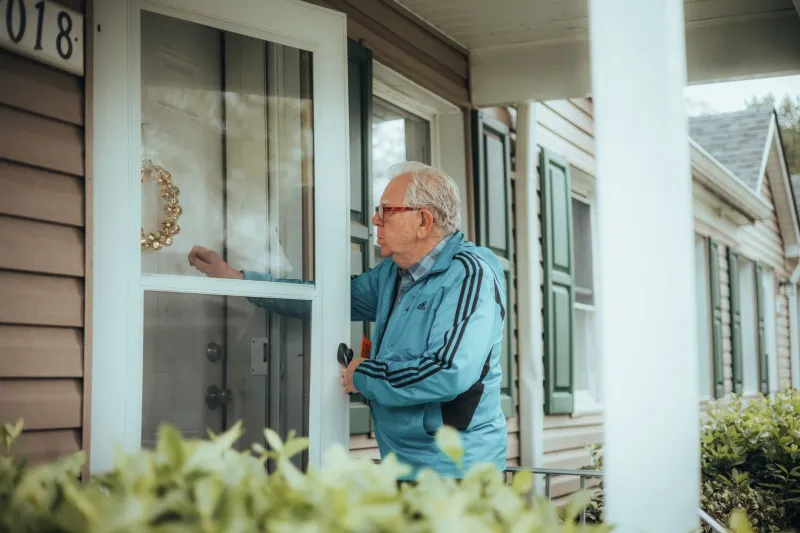
And keep the scale small. A gathering of four people who actually show up beats a gathering of twenty who RSVP. The nervous system does not care about your turnout. It cares whether the porch light was on again this week, and whether it will be on next week.
If you have been waiting for a reason to knock on a door, this is the whole strategy: pick a night, text two neighbors within shouting distance, and bring something from the deli. Then do it again next month, without making it mean anything.